
When I tell people that an expedition cruise is at the top of my travel list, I get one of two reactions. The first is genuine enthusiasm. The second, more common one, involves a look that suggests mild concern for my mental health.
What they’re imagining is me in a parka, stepping around penguin droppings with a group of marine biologists who are very serious about everything. They’re picturing a floating science class. Uncomfortable beds. Mandatory lectures. Maybe a zodiac capsizing somewhere dramatic in the name of adventure.
Here’s what’s funny about that. I am not an intellectual. I don’t pretend to be one. I’m fairly certain I skipped the days in school when they taught everything, and the rest of my academic career (and life) has been spent in quiet confirmation of that. I’m not drawn to expedition cruising because I have a deep background in environmental science or a lifelong passion for marine ecosystems.
I want to go because I want to stand somewhere most people have never been. Somewhere they’ve never even thought about going. Somewhere a little outside what feels possible. And I know from experience that when you put yourself in a place like that, you learn something remarkable whether you were trying to or not. I’ve always believed the world is a classroom. I just don’t enjoy studying ahead of time.
Turns out, that puts me squarely in the middle of who actually goes on expedition cruises.
The people drawn to this kind of travel are not all scientists and academics. Some are. But a lot of them are simply experienced travelers who have been a lot of places and are looking for something that feels genuinely different. They’ve done Europe. They’ve done ocean cruises and river cruises and guided tours. They’ve had wonderful experiences. And somewhere along the way the question shifted from “where should we go?” to “what haven’t we done yet that most people never will?”
Expedition answers that question in a way almost nothing else in travel can.
The experience is built around a small ship. Where mass-market cruises carry thousands of passengers, expedition ships typically carry fewer than two hundred, and many carry closer to a hundred. Small enough that you know everyone on board within a day or two. Small enough to reach places larger vessels simply can’t access or maneuver into. The itinerary doesn’t work like a traditional cruise schedule either. There’s no fixed list of ports on assigned days. The expedition team and the captain assess conditions each morning and decide where to go based on where the experience is actually best that day. Wildlife movement, weather, opportunity. It changes things completely.
A friend of mine was on an expedition cruise in the Galapagos the week after a volcano had erupted on one of the islands. The captain came on and announced they were changing course to get as close as they safely could. My friend said he stood there thinking this does not happen on a ship with three thousand other passengers. He was right. It doesn’t. It can’t.
The guides are a different category entirely from what most travelers are used to. On expedition ships they are marine biologists, naturalists, environmental scientists, historians. People who have built entire careers around understanding one specific place. They interpret what you’re seeing in real time, on the zodiac, on the shore, in the water. The level of knowledge on board is unlike anything you’ll encounter in conventional travel, and the access that knowledge creates is the whole point.
Another friend told me something that his wife said at dinner one night during their expedition cruise, and I haven’t forgotten it. She looked around the dining room and told him to notice everyone’s hair. Wet. Still drying. Ponytails. People who had spent the afternoon in zodiacs or snorkeling and hadn’t bothered to do much about it before dinner. She said they’d never been on a cruise where nobody was performing. No one dressed to impress. No one trying to be seen. Just people who were completely absorbed in where they were, still talking through what they’d seen a couple hours earlier over a good meal. The ship was comfortable, the food was good, the cabins were well appointed. Nobody cared about any of that the way they cared about what had happened outside.
The two destinations most associated with expedition cruising are the Galapagos and Antarctica, and they feel completely different from each other.
The Galapagos is warm, equatorial, and alive in a way that doesn’t feel real until you’re standing in it. The wildlife is so accustomed to human presence that the animals simply don’t move when you walk past. Iguanas on the trail. Sea lions parked at the base of your zodiac. You can snorkel in water so clear and full of life that people consistently describe it as being inside an aquarium. Ecuador protects the ecosystem aggressively. Only a limited number of boats are permitted access, group sizes are capped by law, and guides must meet strict certification standards requiring years of direct experience in the islands. You are not going somewhere that’s been left to chance.
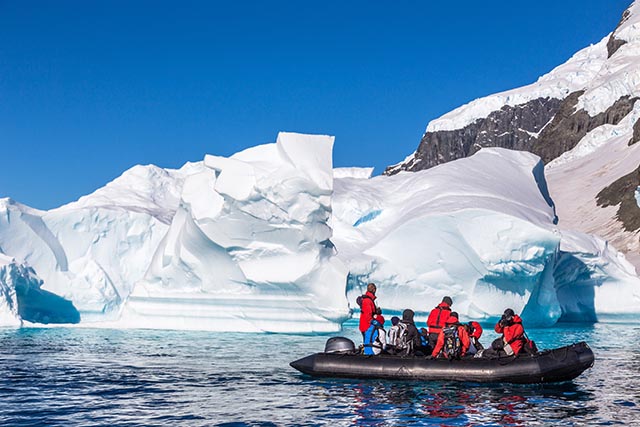
Antarctica is a different thing entirely. Where the Galapagos is warm and teeming, Antarctica is cold, vast, and almost impossibly quiet. Penguin colonies in the hundreds of thousands. Humpback whales surfacing alongside the zodiac. Icebergs the size of buildings drifting past without making a sound. No hotels, no infrastructure, no real indication that humans were meant to be here at all. People who’ve done both describe them as completely different emotional experiences, and I believe it. What they share is the same foundation: a small ship, expert guides, and access to places that most travelers will simply never see.
I haven’t gone to either place yet. But they take two of the spots on my top three “must visit” list. And I know that when I get there I’m going to learn something I wasn’t expecting, from someone who has spent their career in that specific place, in a way I never would have found sitting in a classroom. The world has always been a better teacher than I have been a student. Expedition is one of its best courses.
Expedition is not budget travel. These trips are priced to reflect what they are. The pricing tends to be all-inclusive, which is genuinely different from how most cruises work, and that comparison matters. But there’s no hiding from the base cost. If price is the primary filter, expedition is not the right fit right now.
It is not for short trips. The value of this kind of travel is immersion, and immersion takes time. A few days is not going to get you there.
It requires real physical fitness and mobility. You’re getting in and out of zodiacs multiple times each day, often stepping directly into shallow water before walking onto uneven terrain. Staff are trained to assist at different ability levels and lower-intensity options are typically available, but if sustained outdoor physical activity is genuinely difficult for you, expedition is going to be more frustrating than rewarding.
It’s not right for anyone who wants to relax in the traditional sense. If there’s a pool, it’s not like the ones you’d find on an ocean cruise. No port city to wander through or elaborate shows, and many ships built for expedition don’t have a casino. If familiar comfort is what you’re after, expedition is going to feel like a lot of effort for something you didn’t quite want.
And if being outside in raw, unmanaged wilderness makes you anxious rather than curious, that’s important information. If you’re the type of person who does their best “dancing” in the car avoiding a bee that managed to sneak in with you, think long and hard about whether an expedition adventure is for you.
The people who belong on this kind of trip aren’t all scientists. A lot of them are simply people who’ve been a lot of places and want to go somewhere genuinely rare. Somewhere most of the people they know haven’t been and haven’t considered. Somewhere that asks a little more of them in exchange for something they couldn’t have gotten anywhere else.
If that sounds like you, visit the Start Planning page and let’s have a conversation. We’ll figure out which destination makes sense, what the experience actually requires, and what it’s going to take to get you there.